Editor's brief
2D screens strip away the subconscious cues essential for human rapport. Immersive technology restores this sense of presence, transforming remote work, education, and social connection by replacing flat interfaces with shared spatial environments that mirror real-world interaction.
#Spatial computing
#Virtual reality
#Digital presence
#Remote collaboration
The most exhausting part of a modern video call isn’t the meeting itself, but the cognitive load required to simulate human presence through a grid of two-dimensional rectangles. We have spent decades refining the speed of our connectivity—moving from the delayed cadence of email to high-definition video—yet the quality of interaction has plateaued. A screen, regardless of resolution, remains a barrier that strips away the subconscious data we rely on to build rapport: the slight lean of a shoulder, the intuitive sense of personal space, and true eye contact. When we communicate via a flat interface, we aren't actually "with" someone; we are merely observing a broadcast of them [1]. The Architecture of Presence The transition from 2D screens to immersive technology addresses this deficit by moving the conversation from a window to an environment. In a physical room, the brain processes a massive amount of non-verbal information based on where sounds originate and how others are positioned. Virtual Reality (VR) replicates this by introducing depth and scale, replacing "gallery view" with a shared coordinate system. This shift restores proxemics—the study of how humans use space to communicate. Moving closer to a speaker to show interest or stepping back to give someone room to present happens instinctively, reducing the mental friction of remote communication. This volumetric presence triggers a psychological state known as co-presence, where the brain treats the digital encou...
The most exhausting part of a modern video call isn’t the meeting itself, but the cognitive load required to simulate human presence through a grid of two-dimensional rectangles. We have spent decades refining the speed of our connectivity—moving from the delayed cadence of email to high-definition video—yet the quality of interaction has plateaued. A screen, regardless of resolution, remains a barrier that strips away the subconscious data we rely on to build rapport: the slight lean of a shoulder, the intuitive sense of personal space, and true eye contact. When we communicate via a flat interface, we aren't actually "with" someone; we are merely observing a broadcast of them [1].
The Architecture of Presence
The transition from 2D screens to immersive technology addresses this deficit by moving the conversation from a window to an environment. In a physical room, the brain processes a massive amount of non-verbal information based on where sounds originate and how others are positioned. Virtual Reality (VR) replicates this by introducing depth and scale, replacing "gallery view" with a shared coordinate system. This shift restores proxemics—the study of how humans use space to communicate. Moving closer to a speaker to show interest or stepping back to give someone room to present happens instinctively, reducing the mental friction of remote communication.

This volumetric presence triggers a psychological state known as co-presence, where the brain treats the digital encounter as a genuine physical event. When the proprioceptive system perceives a shared reality rather than a mediated signal, the brain can release oxytocin and dopamine in ways that mirror face-to-face bonding. For those isolated by physical or systemic barriers, such as elderly populations in assisted living, this allows for shared activities—like walking through a digital recreation of a childhood home—that scale emotional intimacy beyond the limits of traditional telecommunications.
Industrializing the Metaverse
This sense of shared space fundamentally alters global collaboration. In traditional remote setups, technical projects often dissolve into a frustrating "can you see my cursor?" loop of disjointed screen-shares. By integrating immersive technology, teams move from discussing a concept to inhabiting it. In high-stakes engineering, platforms like NVIDIA Omniverse allow designers to inhabit a shared "digital twin" of a product. Rather than looking at a flattened projection of a CAD model, engineers stand inside the asset, physically walking around it to identify spatial conflicts in real-time.

This logic extends to the brainstorming process. VR replaces the cluttered digital whiteboard with an infinite canvas where teams can pin ideas to walls and create massive conceptual maps they can physically traverse, restoring the kinetic energy of a physical war room. As decentralized teams become the norm, the office is shifting from a physical address to a persistent virtual hub. These hubs engineer the "watercooler effect," allowing for serendipitous "bump-ins" and unplanned social collisions that maintain company culture without the need for a commute.
Identity and the Social Conduit
VR has moved beyond its reputation as a solitary cell for gaming toward a medium for shared destinations. In platforms like VRChat or Rec Room, the "game" is often secondary to the act of existing together. This transforms the hardware from a gaming peripheral into a social conduit, providing a lifeline for those who find physical social spaces restrictive. Through the Proteus Effect, a user's behavior changes based on their avatar's characteristics [2]. When users align their digital appearance with their internal self-perception, social anxiety often evaporates, leading to more authentic connections.
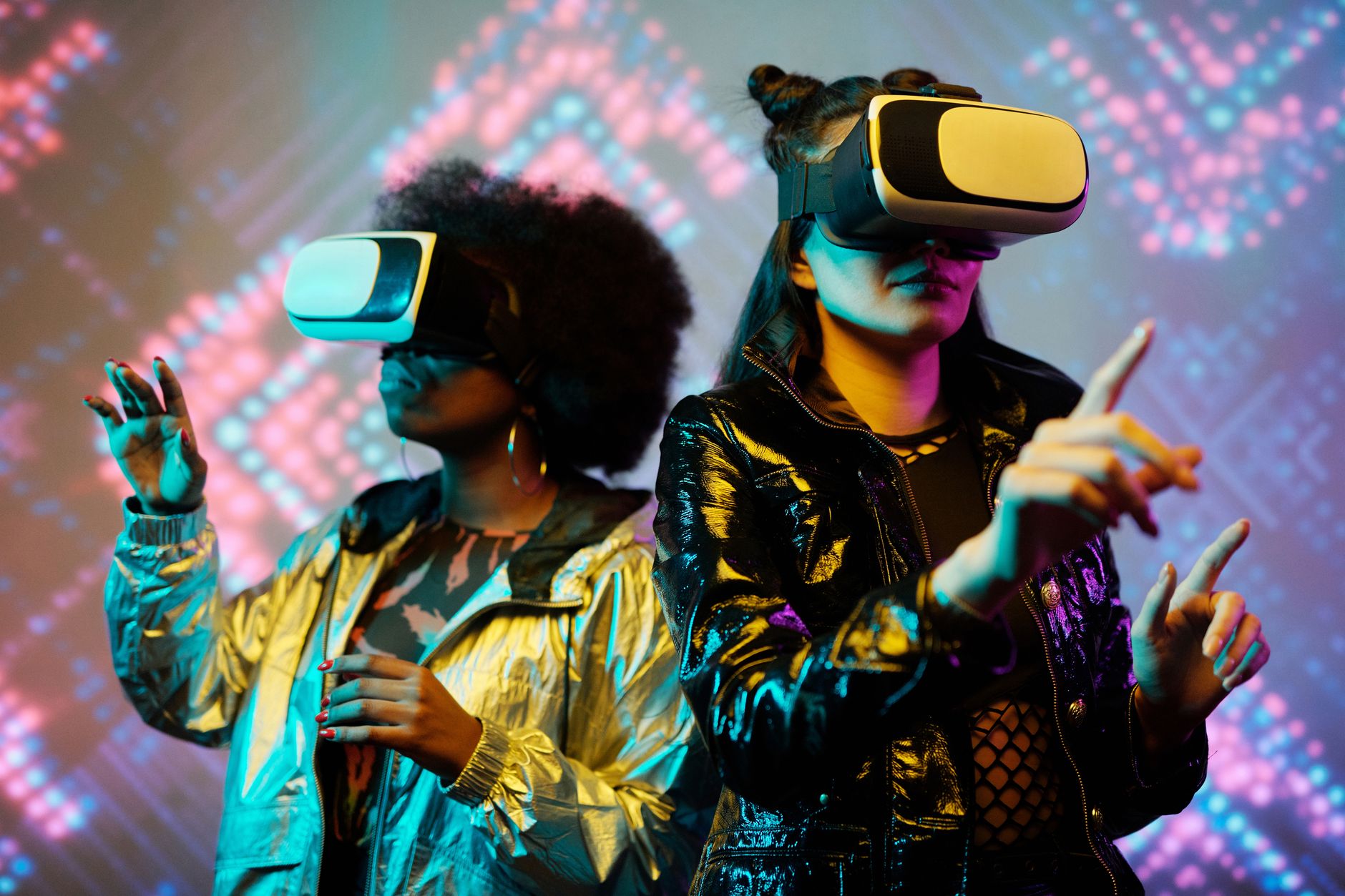
Designers are enhancing this experience by building "impossible architectures"—floating cathedrals or mood-shifting forests—that serve as emotional anchors for community gatherings. To manage these interactions, developers are encoding social norms directly into the software via "personal space bubbles." These invisible barriers prevent avatars from clipping into one another, establishing a new etiquette for a post-physical world. As haptic feedback evolves from simple vibrations to vests and gloves that simulate pressure, the bridge between "remote" and "real" continues to shrink, turning virtual interactions into tactile memories.
The Empathy Machine and Spatial Learning
The gap between a 2D diagram and 3D reality is a primary hurdle in education. Spatial learning is intuitive, whereas abstract reading is an acquired skill. By moving complex systems—such as protein folding or orbital mechanics—into virtual spaces, students can observe concepts rather than struggle to imagine them. This is critical in medical training; platforms like Osso VR provide high-fidelity surgical simulations where the "fail state" is a learning opportunity rather than a catastrophe, allowing surgeons to develop muscle memory before touching a scalpel.

Beyond technical skills, VR functions as an "empathy machine." While traditional media allows us to feel for someone, immersive technology allows us to feel with them by shifting the user's point of view and social context [3]. This capability extends to virtual field trips that dismantle financial and geographic barriers. A student in a rural village can walk through a digitally reconstructed Athenian Agora or explore Mars via NASA datasets, turning the environment itself into the primary textbook.
The Hardware Wall and Network Friction
Despite the potential, the physical reality of the headset remains a significant hurdle. Current hardware often suffers from front-heavy weight distribution, leading to facial fatigue. For VR to move from a scheduled activity to a daily routine, the form factor must evolve from heavy machinery to something resembling oversized eyewear. This is compounded by a financial divide; high-fidelity professional collaboration still requires premium headsets and workstation-grade GPUs, gatekeeping the experience from the average consumer.
Technological friction also manifests as vestibular-ocular conflict, where the eyes perceive motion that the inner ear does not, resulting in motion sickness. While "comfort vignettes" help, a total solution requires lower tracking latencies and higher refresh rates. Currently, the "metaverse" exists as a series of disconnected islands. Until standardized protocols like OpenXR lead to universal avatar interoperability, users must rebuild their identity for every platform they join.

The illusion of presence also depends on the network. A lag of a few dozen milliseconds in a partner's gesture can shatter the feeling of co-presence, triggering a digital version of the uncanny valley. Moving computational lifting to the edge of the network via cloud rendering, supported by 5G and future 6G frameworks, is the only way to achieve high-fidelity interaction without the bulk of onboard processors.
Conclusion
The evolution of digital interaction is a move toward sensory engagement. We are transitioning from an era of the "user" staring at an interface to an era where the interface disappears, leaving only the human connection behind. While hardware ergonomics and network latency remain significant bottlenecks, the shift toward spatial awareness is irreversible. The value of the Metaverse lies not in the graphics or the "game," but in the restoration of the non-verbal cues and shared presence that 2D screens erased. The goal is not to replace physical reality, but to expand the definition of "presence" to any space where we can truly feel the proximity of another person.
References
- J. Bailenson, "Nonverbal Overload: Zoom Fatigue is Real," Stanford Virtual Human Interaction Lab, 2021.
- N. Yee and J. Bailenson, "The Proteus Effect: The Effect of Transformed Self-Representation on Behavior," Human Communication Research, 2007.
- C. Riva et al., "Virtual Reality for the Treatment of PTSD: A Review," Frontiers in Psychology, 2019.

Greetings! Daniel Kim here. I’ve spent 4 years navigating the world of gaming and tech columnist who tracks esports, game design trends, and the communities that form around them., and my roots in South Korea and training in Game Design continue to shape how I tell stories and break down ideas.