Editor's brief
This article provides a comprehensive overview of rocket science, covering fundamental principles like Newton's Laws, launch vehicle architecture, propulsion systems, and orbital mechanics. It highlights advancements driving future space exploration.
Introduction Rocket science, the discipline that empowers us to explore the cosmos, is built upon fundamental yet intricate principles. This article serves as a comprehensive guide, navigating from the bedrock of Newton's Laws of Motion to the complexities of modern propulsion systems, illuminating the path to understanding how we achieve space travel. Unveiling the Fundamentals of Rocket Science At its core, rocket science hinges on surprisingly simple yet profound principles. Understanding how rockets work requires grasping Newton's Laws of Motion, particularly the third law: for every action, there is an equal and opposite reaction [1]. This law is the foundation of rocket propulsion. A rocket expels mass, typically hot gas, out of its nozzle, generating thrust in the opposite direction. The rocket pushes on the exhaust, and the exhaust, in turn, pushes on the rocket, enabling space travel. The effectiveness of thrust is directly linked to the mass and velocity of the expelled gas. Higher mass ejection at greater speeds results in greater thrust [2]. Rocket engines maximize exhaust velocity by burning propellants at high temperatures and pressures, forcing gas through a shaped nozzle to achieve supersonic or hypersonic speeds. A higher exhaust velocity translates directly into more thrust for the same amount of propellant consumed, which is crucial for long-distance space travel. The relationship between a rocket's capabilities, exhaust velocity, and propellant usage is ca...
Introduction
Rocket science, the discipline that empowers us to explore the cosmos, is built upon fundamental yet intricate principles. This article serves as a comprehensive guide, navigating from the bedrock of Newton's Laws of Motion to the complexities of modern propulsion systems, illuminating the path to understanding how we achieve space travel.
Unveiling the Fundamentals of Rocket Science
At its core, rocket science hinges on surprisingly simple yet profound principles. Understanding how rockets work requires grasping Newton's Laws of Motion, particularly the third law: for every action, there is an equal and opposite reaction [1]. This law is the foundation of rocket propulsion. A rocket expels mass, typically hot gas, out of its nozzle, generating thrust in the opposite direction. The rocket pushes on the exhaust, and the exhaust, in turn, pushes on the rocket, enabling space travel.
The effectiveness of thrust is directly linked to the mass and velocity of the expelled gas. Higher mass ejection at greater speeds results in greater thrust [2]. Rocket engines maximize exhaust velocity by burning propellants at high temperatures and pressures, forcing gas through a shaped nozzle to achieve supersonic or hypersonic speeds. A higher exhaust velocity translates directly into more thrust for the same amount of propellant consumed, which is crucial for long-distance space travel.
The relationship between a rocket's capabilities, exhaust velocity, and propellant usage is captured by the Tsiolkovsky rocket equation [3]. This equation mathematically relates the change in velocity a rocket can achieve (delta-v) to the exhaust velocity of its engine and the mass ratio. Achieving a larger delta-v requires either a higher exhaust velocity or a lower mass ratio, or a combination of both.
Achieving a high delta-v is critical for space exploration, determining a spacecraft's ability to perform vital maneuvers such as changing orbits, transferring between orbits, traveling to other planets, course corrections, and slowing down to enter orbit or return to Earth [4]. Optimizing delta-v through advanced propulsion systems and careful mission planning remains at the forefront of rocket science.
The Architecture of Launch Vehicles
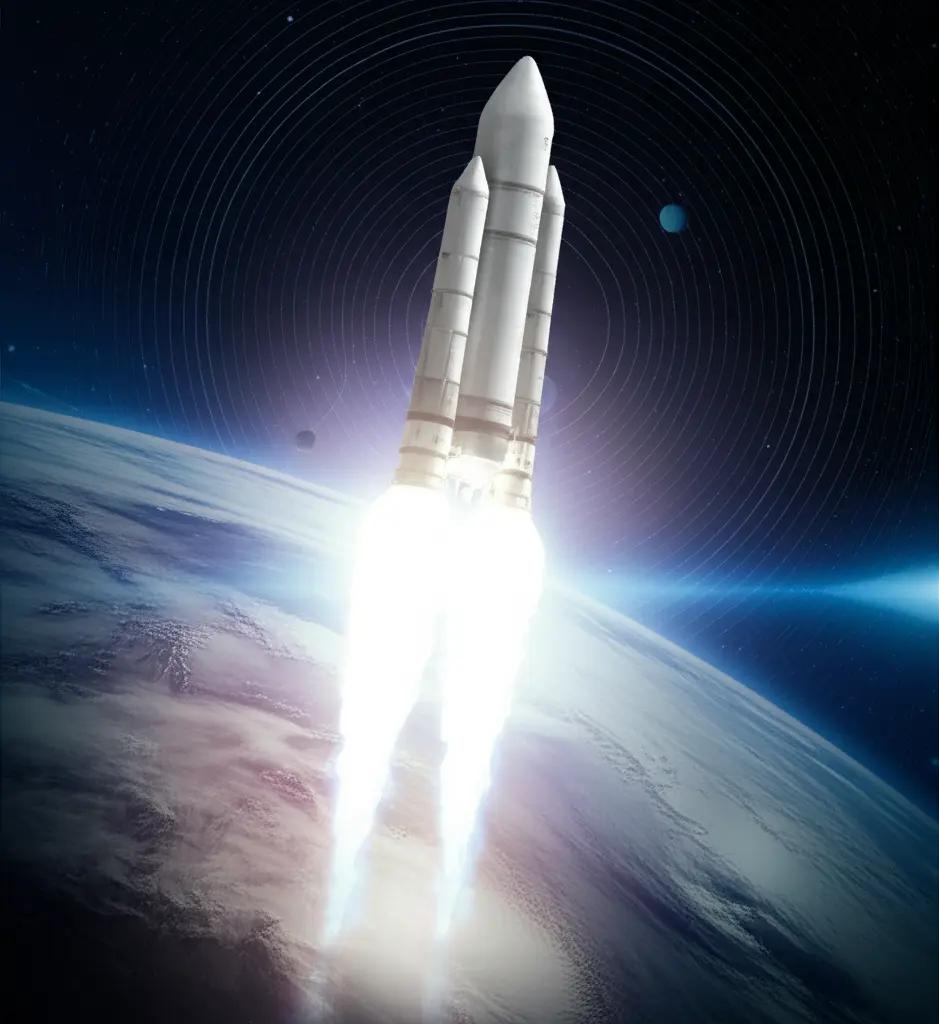
The journey to space relies on launch vehicles, complex multi-staged systems designed to overcome Earth's gravity and deliver payloads into orbit. The design balances power, weight, and aerodynamics, emphasizing efficiency, which is evident in staging [5].
Launch vehicles are multi-staged to maximize efficiency. Each stage includes its own engine(s), fuel tanks, and structure. Once a stage exhausts its fuel, it becomes dead weight. Staging allows for discarding empty fuel tanks, reducing mass and increasing acceleration, according to Newton's Second Law of Motion (F=ma) [6]. The discarded stages burn up in the atmosphere or fall into designated drop zones.
Launch vehicle configurations commonly use parallel or serial staging. Parallel staging attaches boosters to the sides of the main stage, firing simultaneously at liftoff for a thrust boost. Once the boosters burn out, they are detached. Serial staging stacks stages one on top of the other. The first stage fires, and once depleted, it separates, and the next stage ignites [7].
Materials science plays an indispensable role in launch vehicle effectiveness. Engineers seek lightweight and strong materials to withstand extreme launch conditions. Aluminum alloys, titanium alloys, and composite materials are commonly used [8]. Aerodynamic design minimizes air resistance and maintains stability during ascent. Computational fluid dynamics (CFD) simulations optimize the aerodynamic design. The architecture of launch vehicles represents a triumph of engineering, designed to overcome the challenges of reaching space.
Propulsion Systems: Powering Our Journey to the Stars
The ability to traverse space depends on propulsion systems that transform stored energy into directed thrust. Chemical rockets, electric propulsion, and nuclear propulsion represent various approaches. Chemical rockets generate thrust through the combustion of propellants, such as liquid hydrogen and liquid oxygen [9]. The Saturn V rocket exemplifies the power of chemical propulsion. However, chemical rockets are inefficient, requiring vast amounts of propellant.
Solid-propellant rockets offer simplicity and reliability. The fuel and oxidizer are pre-mixed into a solid compound. Once ignited, the combustion is self-sustaining. Solid rockets are ideal for applications requiring high thrust for a short duration, but thrust control is limited. The Space Shuttle used solid rocket boosters for initial launch thrust [10].
Electric Propulsion Systems use electricity to accelerate ions to high velocities. Ion drives ionize a propellant, typically xenon gas, and accelerate the ions using an electric field. While thrust is low, the exhaust velocity is high, resulting in greater propellant efficiency. Ion drives are suited for long-duration missions [11]. The Dawn spacecraft used ion propulsion for interplanetary travel.
Nuclear Propulsion Systems offer the potential for significant improvements. Nuclear thermal propulsion (NTP) uses a nuclear reactor to heat a propellant, generating thrust. Nuclear electric propulsion (NEP) combines a nuclear reactor with an electric propulsion system. However, nuclear propulsion faces technical and political challenges.
Research into advanced Propulsion Systems includes fusion propulsion and antimatter propulsion. Fusion propulsion harnesses energy from nuclear fusion reactions. Antimatter propulsion annihilates matter with antimatter. Both face formidable technical hurdles but offer the prospect of drastically reduced travel times [12]. The future of space exploration is linked to innovative propulsion systems.
Orbital Mechanics: Navigating the Celestial Sphere
Orbital mechanics governs the motion of artificial satellites and spacecraft, dictating how objects move around celestial bodies. It is essential for planning and executing space missions. Orbital mechanics blends classical physics, celestial mechanics, and mathematics to predict and control spacecraft trajectories [13].
The foundations of orbital mechanics rest on Kepler's Laws of Planetary Motion. Kepler's First Law states that planets move in elliptical orbits. The Second Law describes the rate at which a planet sweeps out area. The Third Law relates orbital period to the semi-major axis. These laws apply to artificial satellites, enabling accurate prediction of satellite positions [14].
The Hohmann transfer orbit is a fuel-efficient technique for transferring spacecraft between circular orbits. It utilizes an elliptical orbit tangent to both initial and final orbits, requiring two engine burns. While fuel-efficient, it is relatively slow [15].
Gravitational assists leverage the gravity of planets to alter a spacecraft's speed and trajectory without expending propellant. By approaching a planet along a specific trajectory, a spacecraft can gain or lose velocity [16]. The Voyager and Cassini missions used gravitational assists. Precise calculations and navigation are critical for missions relying on orbital mechanics. Ground-based radar and optical telescopes track spacecraft movements. Onboard navigation systems provide independent measurements. Continuous communication and course corrections are essential.
The Future of Space Exploration Through Rocket Science
The future of space exploration hinges on the evolution of rocket science, transforming science fiction into reality. Advancements promise to revolutionize our ability to explore and inhabit other worlds. Establishing lunar bases, colonizing Mars, and interstellar voyages are increasingly within reach [17].
Reusable Launch Vehicles (RLVs) are shaping the future, with SpaceX's Falcon 9 demonstrating cost reductions through reusability. Reusability lowers the barrier to entry for space activities, fostering innovation and driving down costs. Maturing RLV technology will lead to greater efficiency and reliability [18].
The pursuit of efficient Propulsion Systems is critical for deep-space missions. Advanced concepts like ion drives and nuclear thermal rockets offer the potential to overcome limitations. Ion drives are suited for long-duration missions. Nuclear thermal rockets offer higher thrust and exhaust velocities, potentially halving travel time to Mars [19].
Breakthroughs in advanced materials and manufacturing techniques are essential. Lighter and stronger components maximize payload capacity. Advanced composite materials offer exceptional strength-to-weight ratios. 3D printing enables the creation of intricate geometries and customized parts, reducing manufacturing time and costs [20].
International collaboration addresses the challenges of space exploration. Space exploration is a global endeavor, requiring the pooling of resources and expertise. The International Space Station (ISS) demonstrates the power of international cooperation. Future missions will require greater collaboration, sharing knowledge and resources [21].
References
- Halliday, D., Resnick, R., & Walker, J. (2013). *Fundamentals of Physics* (10th ed.). Wiley.
- Sutton, G. P., & Biblarz, O. (2016). *Rocket Propulsion Elements* (9th ed.). Wiley.
- Tsiolkovsky, K. E. (2013). *The Call of the Cosmos*. Courier Corporation.
- Larson, W. J., & Pranke, L. K. (1999). *Human Spaceflight: Mission Analysis and Design*. McGraw-Hill.
- Humble, R. W., Henry, G. N., & Larson, W. J. (1995). *Space Propulsion Analysis and Design*. McGraw-Hill.
- Anderson, J. D. (2017). *Fundamentals of Aerodynamics* (6th ed.). McGraw-Hill Education.
- Isakowitz, S. J., Hopkins, J. B., & Hertzfeld, H. R. (2017). *International Reference Guide to Space Launch Systems* (5th ed.). AIAA.
- Ashby, M. F. (2011). *Materials Selection in Mechanical Design* (4th ed.). Butterworth-Heinemann.
- Turns, S. R. (2011). *An Introduction to Combustion: Concepts and Applications* (3rd ed.). McGraw-Hill.
- Braeunig, R. A. (n.d.). *Rocket & Space Technology*. Retrieved from View source
- Goebel, D. M., & Katz, I. (2008). *Fundamentals of Electric Propulsion: Ion and Hall Thrusters*. John Wiley & Sons.
- Millis, M. G., & Williamson, G. B. (2009). *Frontiers of Propulsion Science*. American Institute of Aeronautics and Astronautics.
- Bate, R. R., Mueller, D. D., & White, J. E. (1971). *Fundamentals of Astrodynamics*. Dover Publications.
- Vallado, D. A. (2013). *Fundamentals of Astrodynamics and Applications* (4th ed.). Microcosm Press.
- Hohmann, W. (1960). *The Attainability of Celestial Bodies*. NASA Technical Translation F-44.
- Wiesel, W. E. (2010). *Spaceflight Dynamics* (3rd ed.). Apogee Books.
- Angelo, J. A., & Buddington, P. O. (2006). *Space Technology: From Rocketry to the Space Station*. Greenwood Press.
- SpaceX. (n.d.). *Falcon 9*. Retrieved from View source
- Hill, P. G., & Peterson, C. R. (1992). *Mechanics and Thermodynamics of Propulsion* (2nd ed.). Addison-Wesley.
- Gibson, I., Rosen, D. W., & Stucker, B. (2014). *Additive Manufacturing Technologies: 3D Printing, Rapid Prototyping, and Direct Digital Manufacturing*. Springer.
- Messerschmid, E., & Fasoulas, S. (2010). *Space Systems: Architecture, Engineering, and Design*. Springer.
Conclusion
Rocket science is the cornerstone of space exploration, evolving from fundamental principles to sophisticated technologies. From understanding Newton's laws to developing advanced propulsion systems and mastering orbital mechanics, each advancement propels us closer to the stars. As we continue to innovate and collaborate, the future of space exploration holds boundless potential. Dive deeper into the wonders of space – explore the cosmos, contribute to the science, and support the journey beyond our world.

I'm Viktor Mikhailov from Russia. After 18 years working across topics related to science communicator explaining physics, astronomy, and space exploration in clear, accessible language., I’ve discovered that the best writing comes from empathy, clarity, and a genuine desire to connect.