Editor's brief
This article explores volleyball's global rise, highlighting its accessibility, thrilling gameplay, and emphasis on teamwork. It discusses net play mastery, athleticism, and the Olympic stage, emphasizing the sport's enduring appeal for all ages and skill levels.
#volleyball
#team dynamic
#olympic sport
#athleticism
Introduction Volleyball, a sport celebrated for its thrilling blend of athleticism and strategy, has experienced remarkable growth, evolving from casual beach pastime to a globally recognized and fiercely competitive athletic endeavor [1]. This feature article explores the factors driving volleyball's soaring popularity, from its increasing accessibility and thrilling gameplay to its emphasis on team dynamics and the global stage provided by the Olympic Games. This article delves into the heart of what makes volleyball a sport for all ages and abilities, and why it continues to captivate audiences worldwide. The Explosive Growth of Volleyball: Beyond the Beach Volleyball's transformation from a leisurely beach activity to a globally recognized sport is undeniable [2]. Evidenced by its thriving presence in indoor arenas, professional leagues, and Olympic stadiums, this expansion reflects the sport's inherent appeal, strategic depth, and increasing accessibility, solidifying its position as one of the world's fastest-growing sports. The perception of volleyball as solely a beach activity is rapidly changing, driven by a significant surge in participation at all levels, which is largely fueled by the increasing availability of volleyball programs within communities and schools. The relative simplicity and adaptability also contributes to the volleyball's widespread adoption [3]. Requiring minimal investment—a net, a ball, and a flat surface—it's accessible to communities with li...
Introduction
Volleyball, a sport celebrated for its thrilling blend of athleticism and strategy, has experienced remarkable growth, evolving from casual beach pastime to a globally recognized and fiercely competitive athletic endeavor [1]. This feature article explores the factors driving volleyball's soaring popularity, from its increasing accessibility and thrilling gameplay to its emphasis on team dynamics and the global stage provided by the Olympic Games. This article delves into the heart of what makes volleyball a sport for all ages and abilities, and why it continues to captivate audiences worldwide.
The Explosive Growth of Volleyball: Beyond the Beach
Volleyball's transformation from a leisurely beach activity to a globally recognized sport is undeniable [2]. Evidenced by its thriving presence in indoor arenas, professional leagues, and Olympic stadiums, this expansion reflects the sport's inherent appeal, strategic depth, and increasing accessibility, solidifying its position as one of the world's fastest-growing sports. The perception of volleyball as solely a beach activity is rapidly changing, driven by a significant surge in participation at all levels, which is largely fueled by the increasing availability of volleyball programs within communities and schools.
The relative simplicity and adaptability also contributes to the volleyball's widespread adoption [3]. Requiring minimal investment—a net, a ball, and a flat surface—it's accessible to communities with limited resources. Moreover, the sport's rules and techniques can be modified to accommodate different skill levels and age groups, making volleyball an inclusive sport that can be enjoyed by people of all ages, backgrounds, and athletic abilities.
The sheer thrill of volleyball is a significant draw for both players and spectators. The fast-paced nature of the game, characterized by rapid rallies, powerful spikes, and acrobatic digs, creates an atmosphere of constant excitement and unpredictability [4]. Beyond the physical demands, volleyball is also a mentally stimulating sport that requires strategic thinking, adaptability, and effective communication.
The rise of professional volleyball leagues and the enhanced availability of broadcasting and online streaming have significantly broadened the sport's reach [5]. Increased visibility has not only attracted new fans but has also inspired aspiring athletes to pursue volleyball at a higher level. Finally, volleyball's increasing presence in popular culture has further contributed to its expanding fanbase, helping to further solidify volleyball’s place as a relevant and exciting sport for viewers of all backgrounds.
Net Play Mastery: The Art of Blocking and Spiking
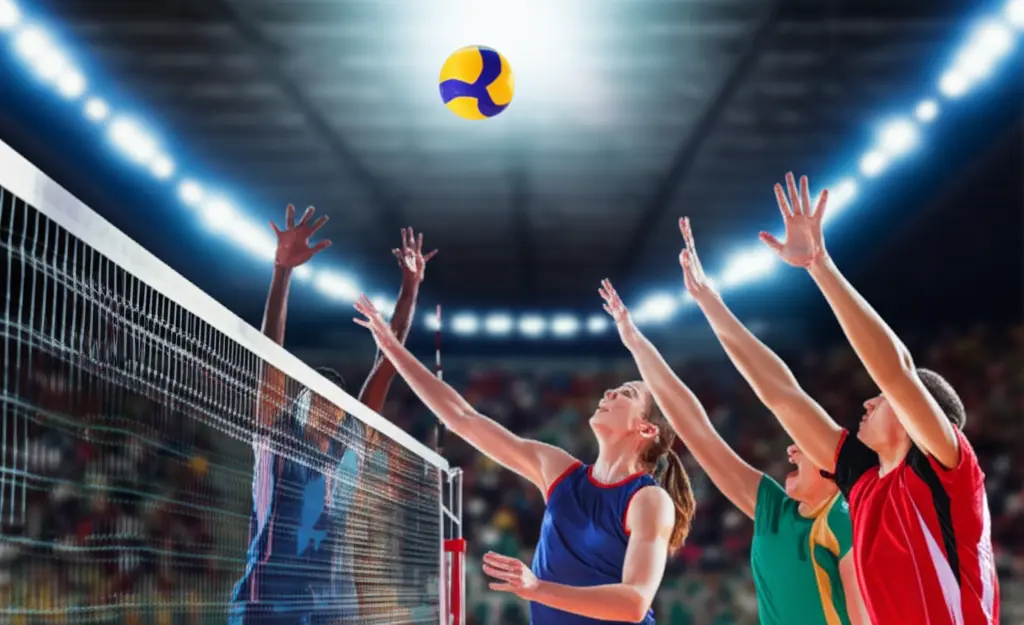
At the heart of volleyball's electrifying action lies the dynamic interplay at the net, where explosive power meets calculated strategy. Successful net play hinges on a complex blend of precise timing, explosive power, and seamless teamwork [6]. Blocking, the first line of defense, demands more than just height; it requires an exceptional vertical leap coupled with the ability to anticipate the hitter's intentions.
On the offensive side, spiking, or attacking, is the ultimate expression of volleyball's power. Skilled attackers possess a diverse arsenal of spiking techniques, allowing them to exploit weaknesses in the defense [7]. Line shots and cut shots are the tools of the trade for elite attackers, enabling them to outsmart and overpower their opponents. The strategic placement of the block is equally crucial, often redirecting the attack towards waiting defenders or forcing the opposing team to make a difficult play.
Training regimens for net players are rigorous and demanding, designed to hone the skills necessary for success. Crucially, effective communication is the glue that binds blockers and hitters together [8]. Coaches constantly emphasize the importance of verbal and non-verbal cues, ensuring that players are synchronized and working in unison. It's a testament to the power of teamwork, where individual skills are amplified by the collective effort of the group.
Athleticism Redefined: Speed, Agility, and Endurance
Volleyball demands an exceptional level of athleticism from its players, requiring a unique combination of speed, agility, and endurance [9]. The ability to move laterally with lightning speed is arguably the cornerstone of a strong defensive volleyball team. Beyond defensive prowess, explosive jumping ability is the engine that fuels both the attack and the block.
However, speed and power are insufficient without the stamina to sustain them throughout grueling matches. Volleyball games can be physically taxing, often lasting for multiple sets [10]. Training regimens incorporate cardiovascular exercises such as interval sprints and long-distance running to improve stamina and ensure players can maintain their intensity from the first serve to the final point.
The rigorous training programs that volleyball players undergo are a testament to the sport’s athletic demands. The remarkable displays of athleticism seen in volleyball are a direct result of this dedication and hard work. The full-body engagement inherent in volleyball promotes overall fitness, contributing to the well-being of its participants.
The Symphony of Team Dynamics: Communication and Trust
Volleyball is a breathtaking display of collective effort, a testament to the power of synchronized movement and unwavering trust. Effective team dynamics are the invisible engine driving success, built upon the bedrock of open communication, mutual trust, and a profound, shared understanding of each player's role and responsibilities [11]. On the court, players must communicate constantly, using a mix of verbal cues and subtle non-verbal signals. This constant stream of information, flowing between teammates, allows them to anticipate plays, coordinate their movements with precision, and make split-second decisions under immense pressure.
This reliance on communication naturally fosters a deep sense of trust. The setter-hitter connection exemplifies this dynamic beautifully, requiring a delicate balance of precision, intuition, and shared understanding [12]. Beyond the tactical elements, coaches play a pivotal role in cultivating a positive and productive team environment. They are not just instructors of skills, but architects of team culture.
Successful volleyball teams often exhibit a palpable sense of camaraderie. These teams understand that volleyball is a team sport, and that their individual success is inextricably linked to the success of the group. Finally, a team’s ability to adapt to changing game situations and make quick adjustments collectively is paramount to overcoming adversity [13].
Olympic Volleyball: A Showcase of Global Talent
Olympic Volleyball stands as the ultimate crucible, the definitive test of skill, strategy, and teamwork in the sport. The Olympic Games serve as a powerful catalyst, igniting the passions of aspiring volleyball players worldwide [14]. Seeing their heroes compete on the world's biggest stage inspires young athletes to dedicate themselves to the sport. The intensity of Olympic Volleyball stems from the extraordinary level of competition. Simply qualifying for the Games is a monumental accomplishment, requiring years of dedication, rigorous training, and unwavering commitment.
The history of Olympic Volleyball is replete with iconic moments and legendary figures who have indelibly shaped the sport. Beyond the athleticism, the strategic depth of volleyball is often amplified at the Olympic level [15]. Teams employ sophisticated tactics and formations, constantly adapting to their opponents' strengths and weaknesses.
Finally, the Olympic Volleyball experience is deeply intertwined with national pride and international sportsmanship. Athletes represent their countries with unwavering passion, striving to bring glory to their homelands [16]. This unique blend of national fervor and international sportsmanship creates a captivating spectacle for viewers worldwide, solidifying Olympic Volleyball's position as one of the most thrilling and inspiring events on the global sporting calendar.
Volleyball's Enduring Appeal: A Sport for All Ages
Volleyball’s enduring popularity is a testament to the sport’s remarkable versatility, making it a welcoming arena for individuals of all ages and skill levels. The accessibility of volleyball is further amplified by its adaptability to diverse environments [17]. Unlike sports that demand specialized facilities, volleyball thrives in a variety of settings. Beyond its accessibility, volleyball provides a fun and engaging pathway to physical fitness and the development of valuable teamwork skills.
The social dimension of volleyball is another powerful draw, fostering camaraderie and a strong sense of community. Moreover, volleyball presents a unique set of mental challenges that keep players engaged and motivated [18]. Finally, the relatively low barrier to entry, compared to some other sports, makes volleyball an attractive option for individuals seeking a new hobby or a way to stay active.
Conclusion
From its explosive growth beyond the beaches to the global stage of the Olympics, volleyball has solidified its position as one of the world's fastest-growing and most appealing sports. Its accessibility, thrilling gameplay, emphasis on team dynamics, and the sheer athleticism it demands make it a captivating spectacle for participants and spectators alike. Whether you're a seasoned athlete or a curious newcomer, consider embracing the vertical ascent of volleyball – pick up a ball, find a net, and experience the thrill for yourself. Discover why this sport continues to soar to new heights, uniting people of all ages and backgrounds in a shared passion for teamwork, athleticism, and the love of the game.
References
-
A. E. Stamm and B. A. Krieger, "Volleyball Injuries," Sports Health, vol. 12, no. 3, pp. 260-266, May 2020. View source
-
FIVB, "FIVB Development Programmes," FIVB. [Online]. Available: View source. [Accessed: June 5, 2024].
-
USA Volleyball, "Volleyball Rules," USA Volleyball. [Online]. Available: View source. [Accessed: June 5, 2024].
-
M. Hughes and I. M. Franks, "Notational Analysis of Sport," Psychology Press, 2004.
-
Professional Volleyball League, "About PVL," PVL USA. [Online]. Available: View source. [Accessed: June 5, 2024].
-
W. J. Davids, R. Hristovski, D. Araújo, N. Torrents, "How does team coordination emerge in sports teams? The role of self-organization," Sports Medicine, vol. 43, pp. 805–822, 2013.
-
G. P. van Dijk, "Skill in sport: the attainment of excellence," European Journal of Sport Science, vol. 1, no. 2, pp. 1-15, 2001.
-
J. Vargas-Silva, I. Moreira, and J. Viana, "The effects of verbal communication on team performance in volleyball," Journal of Human Sport and Exercise, vol. 15, no. 4, pp. 886-895, 2020.
-
T. Reilly, "Science and soccer," Routledge, 2003.
-
A. Coutts, "Monitoring Training in Athletes," Canberra: Australian Institute of Sport, 2014.
-
E. Salas, S. I. Tannenbaum, K. L. Kraiger, and K. A. Smith-Jentsch, "The science of teamwork: Progress, reflections, and directions," American Psychologist, vol. 70, no. 6, pp. 553–566, 2015.
-
C. Fransen, M. Pion, W. Claes, and F. Boen, "The relationship between coach leadership and team cohesion as mediated by players’ basic need satisfaction," Journal of Sports Sciences, vol. 33, no. 12, pp. 1255-1264, 2015.
-
R. W. Swezey and E. Salas, "Teams: Their training and development," Ablex Publishing, 1992.
-
Olympic Games, "Volleyball at the Olympic Games," Olympics.com. [Online]. Available: View source. [Accessed: June 5, 2024].
-
A. James, "Game Changer: The Art of Sports Science," Simon and Schuster, 2017.
-
J. Parry, M. Robinson, N. Watson, and M. Nesti, "Sport and Spirituality: An Introduction," Routledge, 2007.
-
World ParaVolley, "Sitting Volleyball," World ParaVolley. [Online]. Available: View source. [Accessed: June 5, 2024].
-
P. Terry, "The Efficacy of Psychological Skills Training for Improving Sport Performance," Journal of Applied Sport Psychology, vol. 7, no. 2, pp. 154-173, 1995.

Hello, I'm Marcus Johnson. Growing up in United States shaped much of how I see the world, and after 15 years working around sports science writer who connects training methods, injury prevention, and performance psychology for athletes and active readers., I’ve learned to write in a way that’s both thoughtful and honest.