Editor's brief
This article explores the evolution of action games, from early arcade classics to today's immersive VR experiences. It highlights key innovations in gameplay, graphics, storytelling, and the impact of indie developers on the genre's future.
#action game
#game development
#video game
#game history
Action games have evolved dramatically from their humble beginnings, transforming from simple pixelated challenges into immersive, narrative-rich experiences. This article explores the key milestones and innovations that have shaped the genre, from the early days of arcade classics to the cutting-edge technologies of today, highlighting the "adrenaline architects" who have driven this evolution and provides a glimpse into the future of thrilling gameplay. The Genesis of Grit: Action Games Emerge Before sprawling landscapes and photorealistic graphics, there was a simpler time, defined by pixelated heroes and a singular focus on action. Early action games distilled raw adrenaline into digital form, prioritizing immediate reflexes and pattern recognition [1]. Space Invaders and Pac-Man, were tests of skill, reflexes honed by repetition. These titles laid the foundation for the thrilling gameplay experiences we crave today by teaching us that immediate, responsive control, coupled with escalating stakes, could deliver an unparalleled rush. The introduction of scrolling levels marked a pivotal moment, adding depth and a sense of progression beyond the static screen. Imagine trading blows through the scrolling side streets of Kung-Fu Master. The action unfolded dynamically, creating a constant stream of new challenges and visually reinforcing your journey. The increasing difficulty, a hallmark of these early titles, fostered a relentless drive for improvement. Each playthrough was...
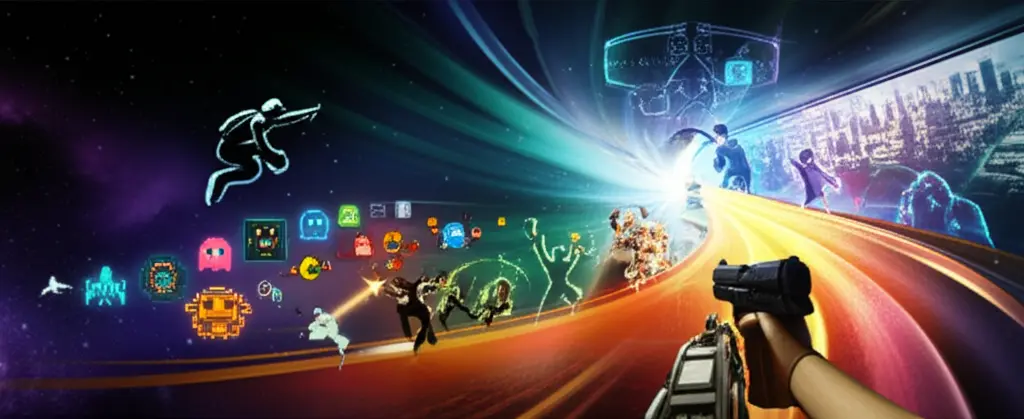
Action games have evolved dramatically from their humble beginnings, transforming from simple pixelated challenges into immersive, narrative-rich experiences. This article explores the key milestones and innovations that have shaped the genre, from the early days of arcade classics to the cutting-edge technologies of today, highlighting the "adrenaline architects" who have driven this evolution and provides a glimpse into the future of thrilling gameplay.
The Genesis of Grit: Action Games Emerge
Before sprawling landscapes and photorealistic graphics, there was a simpler time, defined by pixelated heroes and a singular focus on action. Early action games distilled raw adrenaline into digital form, prioritizing immediate reflexes and pattern recognition [1]. Space Invaders and Pac-Man, were tests of skill, reflexes honed by repetition. These titles laid the foundation for the thrilling gameplay experiences we crave today by teaching us that immediate, responsive control, coupled with escalating stakes, could deliver an unparalleled rush.
The introduction of scrolling levels marked a pivotal moment, adding depth and a sense of progression beyond the static screen. Imagine trading blows through the scrolling side streets of Kung-Fu Master. The action unfolded dynamically, creating a constant stream of new challenges and visually reinforcing your journey. The increasing difficulty, a hallmark of these early titles, fostered a relentless drive for improvement. Each playthrough was a learning experience, a process of memorizing enemy patterns, mastering movement, and refining your strategy. The constant push to overcome adversity, to push your skills to the limit, remains a core tenet of the action genre, even as its complexity has ballooned.
Arcade culture, with its communal atmosphere and competitive spirit, heavily influenced the design philosophy of these early games. Standing shoulder-to-shoulder with friends, swapping strategies, and vying for the highest score created a unique social dynamic. Replayability was king. Games had to be addictive enough to warrant multiple coin drops, and that meant offering a constantly rewarding experience, whether through hidden secrets, escalating difficulty, or the simple satisfaction of improving your personal best. Donkey Kong embodied this arcade ethos. Each successful climb to rescue Pauline was a victory to be celebrated.
“Innovation” in these early games revolved around the clever and resourceful use of limited hardware to create engaging and challenging scenarios. Developers were forced to be incredibly creative, finding ways to squeeze every last drop of performance out of the available technology [2]. This ingenuity led to the development of iconic characters, memorable level designs, and gameplay mechanics that still resonate with players today. The limited color palettes and blocky graphics forced designers to focus on clear visual communication, ensuring that players could instantly understand the rules and react accordingly. The ingenuity displayed in crafting engaging scenarios within these constraints is a testament to the power of creative problem-solving, a legacy that continues to inspire game designers today.
Branching Paths: The Rise of Subgenres
The action game genre split into a diverse ecosystem of subgenres, each catering to different desires and skill sets, and pushing the boundaries of what interactive entertainment could be [3]. This era was fueled by relentless innovation in game design as developers eagerly experimented with novel mechanics and mind-bending level designs, forever changing the face of gaming.
One of the earliest and most enduring offshoots was the platformer. Games like Super Mario Bros. and Sonic the Hedgehog demanded mastery of movement. Leaping across treacherous gaps, precisely timing jumps to bounce off enemy heads, and unraveling the secrets hidden within intricate level layouts became the core experience. Platformers weren't just about reaction time; they were about spatial awareness, problem-solving, and the satisfying feeling of conquering seemingly impossible challenges. Even today, modern platformers like Celeste and Hollow Knight continue to refine the formula, proving that perfectly executed jumps and cleverly designed levels will always have a place in the hearts of gamers.
Then there were the beat 'em ups, games like Streets of Rage and Teenage Mutant Ninja Turtles: Turtles in Time. Forget solitary heroism; these titles were all about cooperative carnage. Grabbing a friend, teaming up to pummel waves of pixelated punks, and unleashing devastating special moves became the ultimate after-school activity. Beat 'em ups tapped into a primal urge for collective action, transforming mundane city streets into arenas for epic showdowns. The genre's appeal lay in its accessibility and the shared thrill of overcoming adversity with friends, making it a staple of arcades and living rooms alike. Modern revivals like Streets of Rage 4 demonstrate that the core appeal of beating down bad guys with a buddy remains as strong as ever, enhanced with updated graphics and more complex combat systems.
On the other end of the spectrum, shoot 'em ups, often abbreviated as "shmups," like Space Invaders, Gradius, and R-Type, presented a different kind of test. These weren't about exploration or teamwork; they were about pure, unadulterated reflexes and strategic brilliance. Piloting a lone spacecraft against overwhelming odds, dodging a relentless barrage of enemy fire, and strategically deploying power-ups became the ultimate challenge. Shmups demanded laser-like focus and an almost preternatural ability to predict enemy movements. The intricate bullet patterns and challenging boss encounters required not just quick reflexes but also a deep understanding of enemy attack patterns and strategic weapon choices. Even in today’s landscape, indie developers are keeping the spirit of shmups alive with innovative new titles that blend classic gameplay with modern aesthetics and design principles.
The 3D Revolution: A New Dimension of Action
The transition to 3D graphics had a paradigm shifting impact on action games, unlocking a universe of possibilities [4]. Before, action games were largely confined to side-scrolling adventures or top-down perspectives, limiting both the scope of gameplay and the player's sense of presence. The advent of 3D unlocked a universe of possibilities, fundamentally reshaping how we experienced virtual action.
The rise of first-person shooters (FPS) and third-person action-adventure games perfectly exemplifies this revolution. Titles like Doom and Quake redefined the rules of engagement. Suddenly, players were thrust directly into the heart of the action, seeing the world through the eyes of their character. This intimate perspective, coupled with the ability to move freely in a three-dimensional space, created an unparalleled sense of immersion. Third-person action-adventure games, such as Tomb Raider and The Legend of Zelda: Ocarina of Time, capitalized on this shift by offering sweeping narratives and intricate environments to explore. Complex narratives and environments became the norm, not the exception. Game developers began to weave elaborate stories, crafting worlds filled with lore, intrigue, and memorable characters. These games weren't just about mindless action; they were about experiencing compelling stories in interactive form.
The move to 3D also brought about a massive evolution in character movement and combat systems. No longer were players restricted to simple jumps and attacks. Suddenly, they could perform complex maneuvers, utilize a wide range of weapons, and engage in strategic combat. Games like Devil May Cry and Ninja Gaiden raised the bar for action game mechanics, introducing intricate combo systems, aerial combat, and a focus on stylish and precise movements. This emphasis on player expression allowed gamers to feel more connected to their characters and more invested in mastering the game's mechanics. Tactical depth was also enhanced, demanding thoughtful resource management, strategic positioning, and skillful execution of moves.
One of the most profound impacts of the 3D revolution was the emergence of open-world environments. Games like Grand Theft Auto III and The Elder Scrolls III: Morrowind broke free from linear level design, offering players unprecedented freedom to explore vast, interconnected worlds. This shift blurred the lines between action games and role-playing games, creating a hybrid genre that emphasized both intense action and deep character customization. Players could now carve their own path through the game world, choosing their own objectives, forging alliances, and shaping their own destinies. This level of agency and immersion was revolutionary, transforming action games from structured experiences into living, breathing worlds.
In retrospect, the 3D revolution wasn't just a technological advancement; it was a catalyst for creativity and innovation. It marked a significant step forward in the trajectory of future gaming, pushing developers to constantly redefine the boundaries of what was possible. It laid the groundwork for the immersive, cinematic, and deeply engaging action games we enjoy today.
Narrative Takes Center Stage: Action Games Grow Up
Storytelling has evolved from a simple backdrop to an integral, often dominant, force driving the modern action game experience [5]. Developers are now crafting intricate narratives filled with compelling characters, intricate motivations, and emotionally resonant moments. Think of games like The Last of Us or God of War (2018). They're not just about blasting enemies; they're about the complex relationships between characters navigating harrowing circumstances, making difficult choices, and facing profound loss. These studios are essentially building interactive dramas, and the action serves to amplify the emotional impact of the narrative.
This cinematic presentation is no accident. Developers are increasingly borrowing techniques from filmmaking, employing dynamic camera angles, motion capture technology, and professional voice acting to enhance the player's immersion. The goal is to blur the lines between interactive entertainment and blockbuster movies. Consider the opening sequence of Uncharted 2: Among Thieves, a heart-pounding escape from a derailed train hanging off a cliff. The scene is meticulously crafted, drawing you in with its visual spectacle and Nathan Drake's witty banter, all while forcing you to make split-second decisions. This level of polish and attention to detail elevates the entire experience, making it more engaging and believable. It’s not just about seeing the action; it’s about feeling it, being emotionally invested in the outcome.
Furthermore, modern action games are empowering players with agency in shaping the narrative. Moral choices, branching storylines, and character customization allow players to define their protagonist's personality, relationships, and ultimate fate. Games like Detroit: Become Human exemplify this trend, where every decision carries weight and has tangible consequences on the story's trajectory and the fates of the characters involved. These choices add depth and replayability, encouraging players to explore different paths and uncover new endings. It moves beyond a simple "good" or "bad" ending, challenging players to grapple with morally gray areas and the complex ramifications of their actions.
The integration of these narrative elements elevates the thrilling gameplay beyond mere mechanical challenge. It's no longer simply about mastering combos or completing objectives; it's about understanding the why behind the action. Why are you fighting these enemies? What are you fighting for? What will happen if you fail? This contextualization transforms the gameplay from a series of disconnected actions into a meaningful and impactful experience. A perfect headshot isn't just a satisfying mechanical feat; it's a crucial moment that could save a life, turn the tide of battle, or alter the course of the story.
This shift towards narrative-driven action games reflects a growing sophistication in the gaming audience. Players are no longer satisfied with mindless action; they crave more engaging and thought-provoking content. They want to be emotionally invested in the characters and their stories, to feel the weight of their decisions, and to experience narratives that resonate with them on a deeper level. This demand has pushed developers to innovate and experiment, resulting in a diverse and exciting landscape of action games that offer both thrilling gameplay and compelling storytelling. This trend suggests that the future of action gaming lies in even more sophisticated and immersive narratives, blurring the lines between games, movies, and interactive dramas, promising experiences that are as emotionally resonant as they are adrenaline-pumping.
Multiplayer Mayhem: The Rise of Competitive and Cooperative Action
Multiplayer modes have exploded from a simple add-on to a cornerstone of the action game experience, transforming single-player adventures into potentially endless arenas of competitive and cooperative gameplay [6]. Now, online matchmaking and robust social features have connected players from every corner of the globe, creating vibrant communities buzzing with shared experiences, strategies, and the constant pursuit of digital dominance. This interconnectedness has not only dramatically extended the replayability of action games but has also fostered a whole new level of engagement. Think about games like Apex Legends or Call of Duty: Warzone – their core appeal lies not just in the shooting mechanics, but in the dynamic interactions and emergent narratives that unfold organically within each match, fueled by the unpredictability of human opponents and the drive to achieve victory as a team.
But it's not just about fragging out; team-based gameplay and objective-driven modes have injected a significant dose of strategic depth into the traditionally fast-paced world of action games. No longer can you simply run and gun your way to success. Instead, coordinated attacks, tactical positioning, and clear communication are paramount. Consider the intricacies of a game like Rainbow Six Siege, where meticulously planned breaches, strategic gadget deployment, and a deep understanding of map layouts are essential for overcoming your opponents. This emphasis on tactical considerations elevates the genre beyond mere reflexes, demanding players to think critically, adapt to changing circumstances, and work together seamlessly as a cohesive unit. The rise of class-based systems further enhances this strategic layer, forcing players to consider their role within the team and coordinate their abilities to maximize their effectiveness.
The impact of multiplayer on the action gaming landscape is undeniable, culminating in the meteoric rise of esports. These professional gaming leagues showcase the astonishing skill, dedication, and spectacle of competitive action games on a global stage. Millions of viewers tune in to watch the world's best players compete for massive prize pools, cementing action games as a legitimate form of entertainment and athletic competition. The precision, teamwork, and split-second decision-making displayed by esports professionals are truly breathtaking, inspiring aspiring gamers and pushing the boundaries of what's possible within these virtual worlds. Esports not only provides a platform for elite players to showcase their talents but also fuels further innovation within the industry, as developers constantly strive to create games that are both engaging for casual players and competitively viable for the pros.
Looking ahead, the innovation in multiplayer design shows no signs of slowing down. Developers are constantly experimenting with new modes, mechanics, and social features to keep players engaged and invested. From asymmetrical multiplayer experiences that pit small teams of powerful hunters against hordes of weaker prey, to persistent online worlds where players can build communities, forge alliances, and compete for resources, the possibilities are endless. The competitive spirit, the camaraderie of teamwork, and the constant quest for innovation will continue to drive the evolution of this exciting and ever-evolving genre.
The Cutting Edge: VR, AR, and the Future of Immersion
Virtual reality (VR) and augmented reality (AR) are the architects poised to revolutionize how we experience action games, promising immersion levels previously only achievable in our wildest imaginations [7]. Imagine stepping into the boots of your favorite character, truly feeling the weight of their weapon, the sting of the wind, and the earth-shattering impact of a perfectly executed takedown. This isn't just about better graphics; it's about redefining presence, blurring the lines between the digital and the real.
These technologies aren't just about visually transporting us; they’re about fundamentally changing how we interact with game worlds. Forget button mashing; VR and AR allow players to physically interact with their environment. Think about reaching out and grabbing a weapon from a virtual rack, dodging a projectile in real-time by physically moving your body, or collaborating with teammates using hand gestures in a shared AR battlefield. The possibilities are as vast as the digital landscapes these technologies can create. This level of physical interaction intensifies the sense of presence, making every victory feel that much sweeter and every defeat that much more crushing. It’s no longer enough to just see the action; you have to become the action.
And with these new technologies come new forms of thrilling gameplay. We're talking about experiences that go beyond the traditional controller-based mechanics. Imagine a survival horror game where the creaks and groans of the environment aren't just sounds, but directional audio cues that force you to physically turn your head to locate the source of the impending danger. Envision a tactical shooter where you physically lean around corners to peek at enemy positions, using real-world cover to your advantage. Consider the visceral impact of a melee combat game where you have to actually swing your arms to attack, feeling the strain in your muscles as you fend off hordes of enemies. This is more than just gaming; it's a physical and mental workout, a true test of reflexes and strategy.
Of course, the path to fully immersive action gaming isn't without its bumps and bruises. Hardware adoption remains a significant hurdle. VR headsets and AR glasses can be expensive, putting them out of reach for many gamers. Furthermore, the technology is still evolving, and issues like motion sickness and clunky interfaces need to be addressed. Development costs are also a factor; creating compelling VR and AR experiences requires specialized skills and equipment, which can strain even the budgets of large studios. But even with these challenges, the momentum is undeniable. Major players in the industry are investing heavily in VR and AR research and development, and we're already seeing a steady stream of innovative games that push the boundaries of what's possible.
Finally, game design itself is undergoing a radical transformation. Developers are no longer limited by the constraints of traditional input devices; they're free to experiment with novel control schemes and interaction paradigms. We’re seeing the rise of gesture-based controls, voice commands, and even brain-computer interfaces that allow players to manipulate the game world with their thoughts. This shift is forcing designers to rethink everything from level design to narrative structure, creating entirely new genres and subgenres within the action game landscape. The future of action gaming isn't just about more realistic graphics; it's about fundamentally redefining how we interact with and experience the virtual world, turning us from passive observers into active participants in the unfolding drama.
Indie Innovation: New Voices, Bold Ideas
The indie game scene has become a veritable crucible of innovation in action gaming, with developers fearlessly experimenting with unconventional mechanics and aesthetics [8]. AAA studios are like meticulously crafted sports cars, indie studios, on the other hand, are more like mad scientist workshops, churning out bizarre and beautiful creations that redefine what an action game can be. They're not afraid to get their hands dirty, to break the rules, and to build something truly unique from the ground up.
Indie games often challenge established conventions and push the boundaries of game design. For years, action games have often defaulted to predictable narratives, repetitive combat loops, and uninspired level design. Indie developers, unburdened by the financial pressures of blockbuster releases, are free to deconstruct these norms and rebuild them in unexpected ways. Consider Hollow Knight, a Metroidvania that elevates exploration and atmospheric storytelling to an art form, surpassing many of its AAA counterparts. Or take Katana ZERO, a neo-noir action platformer where one-hit kills force players to meticulously plan each encounter, transforming the typical "run and gun" approach into a deadly ballet of reflexes and foresight. They inject fresh ideas into a genre sometimes accused of stagnation, ensuring the adrenaline rush feels brand new.
These titles often offer unique and memorable experiences, appealing to players seeking something different from mainstream action games. In a world saturated with sequels and reboots, indie games offer a refuge for those craving originality. They’re the unexpected gem you stumble upon after hours of scrolling, the game that sticks with you long after you've finished playing. Think about the impact of Hotline Miami, with its brutal, top-down violence, pulsing synthwave soundtrack, and unsettling narrative. It's a game that gets under your skin, forcing you to confront the consequences of your actions in a way that few AAA titles dare to. Or imagine the sense of discovery in Noita, where every pixel is physically simulated, leading to emergent gameplay scenarios that are both hilarious and devastating. It's this kind of unpredictability and handcrafted uniqueness that draws players into the indie realm, offering a personalized and impactful gaming experience far removed from the mass-produced feel of some larger titles.
The success of indie action games demonstrates the importance of creativity and originality in the industry, proving that you don't need a massive budget to create a compelling and thrilling experience. The success stories of indie darlings like Dead Cells, a rogue-lite Metroidvania praised for its fluid combat and addictive gameplay loop, or Celeste, a challenging platformer with a surprisingly moving narrative about mental health, demonstrate that a dedicated team with a strong vision can make a significant impact. These games show that genuine creativity, combined with smart design and compelling gameplay, can resonate with players on a deeper level than even the flashiest graphics or the biggest marketing campaigns. They're a testament to the power of indie ingenuity.
Finally, indie developers frequently create new takes on thrilling gameplay by merging genres or creating unique control schemes. They aren't bound by pre-existing categories and eagerly mash together elements from different genres to forge something truly unique. Picture Synthetik: Legion Rising, a top-down shooter that blends the tactical depth of a roguelike with the satisfying gunplay of a modern action game. Or consider Devil Daggers, a minimalist arena shooter that strips away all unnecessary complexity, forcing players to focus on pure, unadulterated skill and reflexes. These experimental approaches result in gameplay experiences that are both challenging and rewarding, pushing players to adapt to new rules and master unfamiliar mechanics. They prove that the possibilities for innovation in action gaming are virtually limitless, as long as developers are willing to think outside the box and embrace the unconventional. The adrenaline rush they offer is not just from quick reflexes but from mastering something genuinely new and challenging.
Conclusion
From the pixelated simplicity of early arcade games to the immersive and narrative-rich experiences of today, the action genre has undergone a remarkable transformation. Innovations in graphics, gameplay mechanics, storytelling, and multiplayer functionality have continuously pushed the boundaries of what's possible, offering players increasingly thrilling and engaging experiences. The rise of VR and AR technologies, coupled with the creativity of indie developers, promises an even more exciting future for action gaming. So, grab your controller (or VR headset), dive in, and prepare to experience the next level of adrenaline-fueled adventure. What are you waiting for?
References
-
Rollings, A., & Adams, E. (2003). Andrew Rollings and Ernest Adams on game design. Pearson Education.
-
Crawford, C. (2003). Chris Crawford on game design. New Riders.
-
Bjork, S., & Holopainen, J. (2005). Patterns in game design. Charles River Media.
-
Ebert, S. (2007). 3D game design with 3D toolmaker. Wordware Publishing, Inc.
-
Bateman, C., & Boon, R. (2006). 21st century game design. Charles River Media.
-
Morris, S., & Nowak, J. (2006). Game development essentials: Game artificial intelligence. Cengage Learning.
-
Sherman, B., & Craig, A. B. (2019). Understanding virtual reality: Interface, application, and design. Morgan Kaufmann.
-
O'Donnell, C. (2014). Developer's dilemma: The secret lives of video game creators. MIT Press.

Greetings! Daniel Kim here. I’ve spent 4 years navigating the world of gaming and tech columnist who tracks esports, game design trends, and the communities that form around them., and my roots in South Korea and training in Game Design continue to shape how I tell stories and break down ideas.